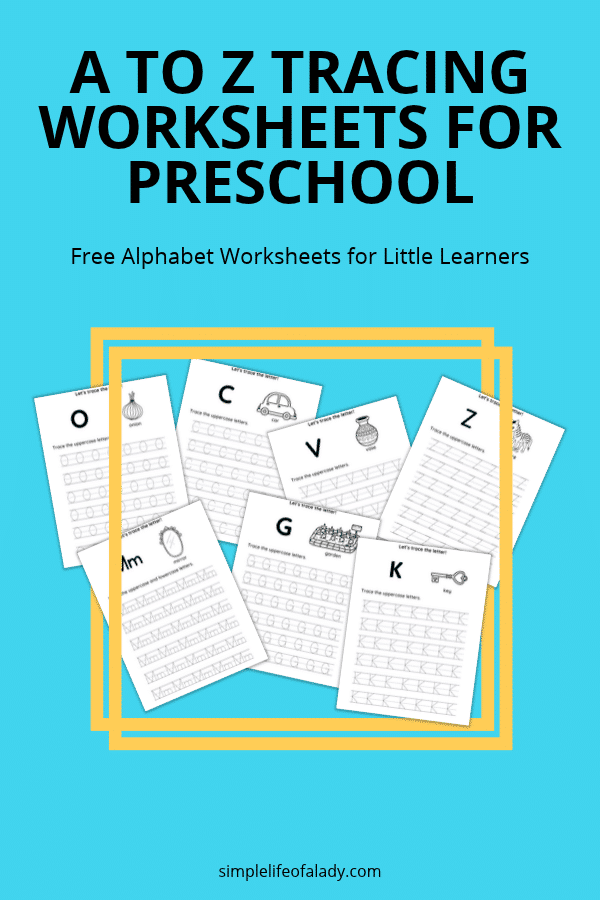
These free A to Z tracing worksheets for preschool will help your child practice recognizing and writing the letters of the alphabet, one letter at a time. Print the worksheets you need and let your little one learn at his own pace!
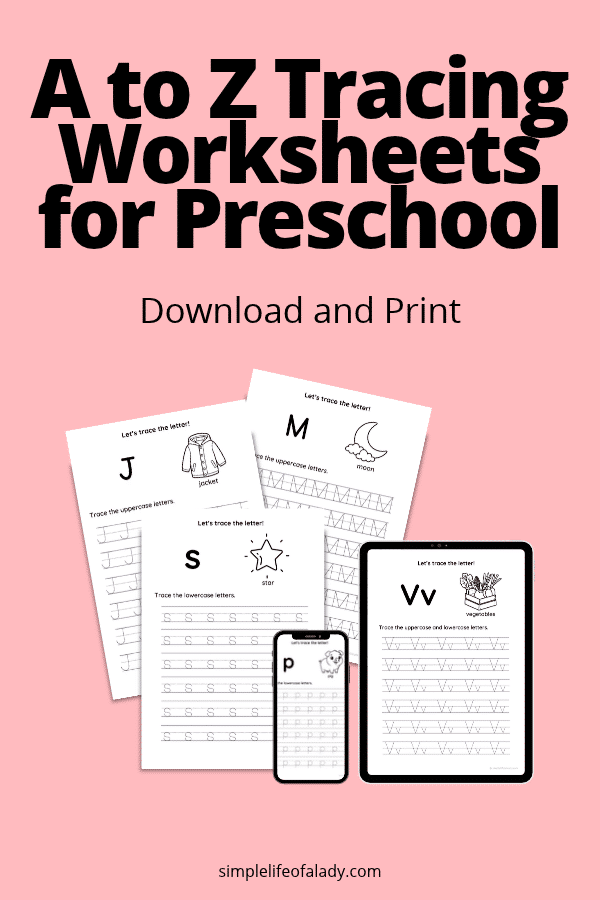
Teaching your preschooler the alphabet can be a wonderful part of your days together.
But you don’t have to teach all 26 letters at once. You don’t need to finish a certain number of worksheets every day, either.
Sometimes, learning a letter means sitting down for a few minutes to trace it. Other times, it means pointing out the letter on a book cover, recognizing it on a sign, or trying to write it on a blank piece of paper.
The important thing is to give your child opportunities to become familiar with letters without putting too much pressure on him.
That’s why I’ve put together these free alphabet tracing worksheets for preschool. You can use them to introduce the letters, practice writing, or simply give your child a little extra time with the alphabet.
Let’s get started!
Free A to Z Tracing Worksheets for Preschool
Below, you’ll find tracing worksheets for all 26 letters of the alphabet, from A to Z.
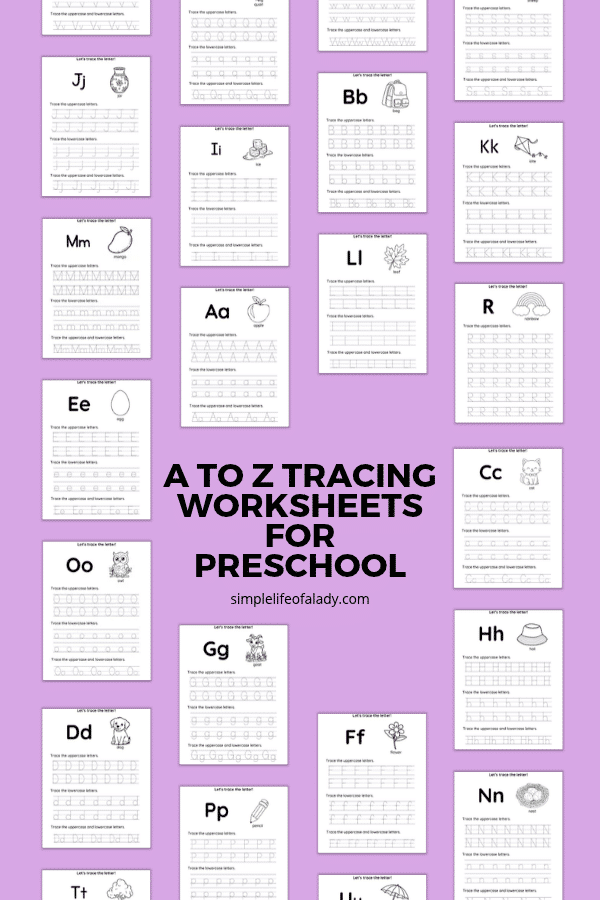
Each worksheet focuses on one letter and includes uppercase and lowercase letter tracing. You can print the letters individually, so your child can practice the letter he’s currently learning instead of working through the entire alphabet at once.
Click on any letter below to visit its worksheet page and download the free printable.
- Letter A Tracing Worksheets for Preschool
- Letter B Tracing Worksheets for Preschool
- Letter C Tracing Worksheets for Preschool
- Letter D Tracing Worksheets for Preschool
- Letter E Tracing Worksheets for Preschool
- Letter F Tracing Worksheets for Preschool
- Letter G Tracing Worksheets for Preschool
- Letter H Tracing Worksheets for Preschool
- Letter I Tracing Worksheets for Preschool
- Letter J Tracing Worksheets for Preschool
- Letter K Tracing Worksheets for Preschool
- Letter L Tracing Worksheets for Preschool
- Letter M Tracing Worksheets for Preschool
- Letter N Tracing Worksheets for Preschool
- Letter O Tracing Worksheets for Preschool
- Letter P Tracing Worksheets for Preschool
- Letter Q Tracing Worksheets for Preschool
- Letter R Tracing Worksheets for Preschool
- Letter S Tracing Worksheets for Preschool
- Letter T Tracing Worksheets for Preschool
- Letter U Tracing Worksheets for Preschool
- Letter V Tracing Worksheets for Preschool
- Letter W Tracing Worksheets for Preschool
- Letter X Tracing Worksheets for Preschool
- Letter Y Tracing Worksheets for Preschool
- Letter Z Tracing Worksheets for Preschool
How to Use These Alphabet Tracing Worksheets
You don’t need a complicated lesson plan to use these worksheets. A few minutes of practice can be enough for a preschooler, especially when you’re just introducing a new letter.
Here are a few simple ways to use them at home.
1. Start With One Letter at a Time
Choose a letter your child is currently learning. You might start with the first letter of his name, a letter he recognizes, or whichever letter he is most interested in.
Let him become familiar with that letter before moving on to another one.
In our case, I’ve introduced these letters to my son one letter each week, and that has worked just fine for us.
There were many times when he would already write the letter even without the worksheet yet.
So, there really is no need to rush through all 26 letters. Some letters will come easily, while others may need more practice.
What’s important is that you work at your child’s pace and do not compare him to other preschoolers.
2. Practice Both Uppercase and Lowercase Letters
The alphabet has uppercase and lowercase letters, and children gradually learn to recognize both forms.
These worksheets give your child opportunities to trace both uppercase and lowercase letters. You can point out how the two forms look different while explaining that they represent the same letter.
For example, you can show him uppercase A and lowercase a, then look for those letters together in a favorite book.
There will be times when your child will prefer the uppercase or the lowercase and might not want to trace the other. This is completely fine.
Gradually, he’ll become interested in tracing both, too. So just be patient, Mama. You’ll get there.
3. Keep Practice Sessions Short
Preschoolers don’t need long handwriting lessons.
Start with a few minutes and see how your child responds. If he’s enjoying the activity, you can continue. If he’s getting tired or frustrated, it’s perfectly fine to stop and try again another day.
Remember, the goal is to help him become familiar with letters, not to finish every worksheet in one sitting.
And for the record my son finished only a few of these worksheets. I didn’t force him to finish anything. But right now, after about seven months, he’s already writing these letters and all on his own.
He likes writing them without the worksheets. He writes his name too even if I haven’t made him a tracing worksheet for that yet. I’m even thinking I might not need to make a worksheet for that anymore.
And what can I say? I’m just one happy, satisfied, and proud mom!
4. Let Your Child Practice at His Own Pace
Some children enjoy tracing letters repeatedly. Others prefer to try writing on their own or move on to another activity after a few minutes.
You can offer guidance without expecting every letter to look perfect.
If your child is still developing the hand control needed for tracing, give him time. Playing with blocks, drawing, coloring, and other hands-on activities can also support the skills he uses for writing.
And if there’s just one tip I want to leave you with when using these letter-tracing worksheets, it’s this one.
Follow your child’s pace. That’s it. Plain and simple. You’ll see him improve over time.
5. Make Letter Learning Part of Everyday Life
Worksheets don’t have to be the only way your child learns the alphabet.
You can point out letters on food packaging, read alphabet books together, sing the alphabet song, or look for letters on signs when you’re out.
These everyday moments help connect the letters on the page to the world around your child.
And keep it fun! Learning can be much more enjoyable for preschoolers when they get to explore, play, and discover things at their own pace.
What If My Preschooler Isn’t Ready to Trace Every Letter?
That’s okay!
Preschoolers develop at different rates, and being able to recognize a letter doesn’t necessarily mean a child is ready to write it independently.
You can introduce tracing gently and let your child explore other ways of learning letters, too.
For example, you might:
- Point to letters while reading together.
- Let your child draw freely with crayons or pencils.
- Form letters with play dough.
- Look for a particular letter around your home.
- Practice writing in short, relaxed sessions.
You can return to the worksheets whenever your child is ready for more practice.
And if your preschooler already knows how to write some letters, you don’t have to make him trace every single one.
Let the worksheets support his learning rather than become a task he has to complete.
A Simple Way to Learn the Alphabet at Home
Teaching the alphabet doesn’t have to mean sitting at a table for hours or following a strict schedule.
You can work on letters during a quiet morning, after breakfast, or whenever your family has a little time together.
Some days, your child might complete a worksheet. Other days, you might only read a book, sing a song, or point out a few letters.
All of these moments can be part of learning at home.
As you work through the alphabet, remember that your child doesn’t need to master every letter immediately. Give him opportunities to practice, celebrate his efforts, and allow him time to grow.
You don’t have to make preschool complicated to make it meaningful.
Start with any letter above, print the worksheet, and enjoy learning together!
And if you’d like to keep these worksheets handy for later, pin this post on Pinterest so you can easily find it whenever your child is ready for more letter practice!